

Entryways fail for a predictable reason. Everything arrives at once, usually while your hands are full, and there is nowhere for any of it to go. Shoes come off, keys and mail hit the nearest flat surface, and a bag lands on the floor. Within a week the console table is buried and the shoes have spread halfway down the hall.
Storage helps, but only the right kind. Water hyacinth baskets for the entryway work well here because they are open, quick to use, and good looking enough to leave in the most visible spot in your home. This guide covers what actually works in a drop zone, what does not, and how to set one up that your household will still be using in six months.
Why the entryway is different from every other room
Most rooms let you organize at your own pace. The entryway does not. You are arriving or leaving, usually in a hurry, often carrying things. That single constraint decides everything about what works.
Systems that require a decision fail here. Lids fail. Drawers mostly fail. Anything more than two steps out of your natural path fails. What survives is open containers placed exactly where you already stop, because they take one motion and no thought.
That is why baskets outperform most purpose-built entryway furniture. A shoe rack asks you to place each pair neatly. A basket asks you to drop them in. Guess which one gets used on a wet Tuesday evening.
Woven baskets have a second advantage in this room. Your entryway is the first thing a guest sees, so utility storage reads badly here. Plastic bins and wire racks make a hallway feel like a garage. Natural fiber gives you the same function without that trade-off.
Start by mapping your drop zone, not your storage
Before buying anything, watch what actually happens for a few days. Where do you genuinely stop? Where do the shoes land? Which surface collects the mail?
Almost everyone has a natural drop point that is different from where they think their storage should be. If you always dump things on the shelf by the door but your console sits two metres further in, put the catchall by the door. Fighting your own habit never works. Design around it instead.
Once you know your drop point, you usually need three zones and nothing more:
- A small stuff zone for keys, mail, sunglasses, and wallets
- A shoe zone on the floor near the door
- A seasonal zone for scarves, hats, gloves, or umbrellas, depending on the time of year
Adding a fourth zone is where most entryways go wrong. More containers means more sorting decisions, and sorting decisions are exactly what nobody makes while holding groceries.
Keys, mail, and the small stuff
This is the zone that fails most often, and the reason is almost always the container.
Keep it shallow. Deep baskets swallow small items. You end up digging for keys with one hand, which is worse than having no basket at all. A low, open shape lets you see everything at a glance.
One container, not three. Separating keys, mail, and sunglasses seems tidy but adds decisions. In practice people skip the sorting and leave things loose on the surface. One catchall that gets emptied weekly beats a filing system nobody maintains.
Give mail a rule. Mail is what actually clogs a catchall because it arrives faster than anything else. The habit that works: recycle junk at the door, and let only items needing action stay in the basket. When the basket looks full, that is your prompt to deal with it.
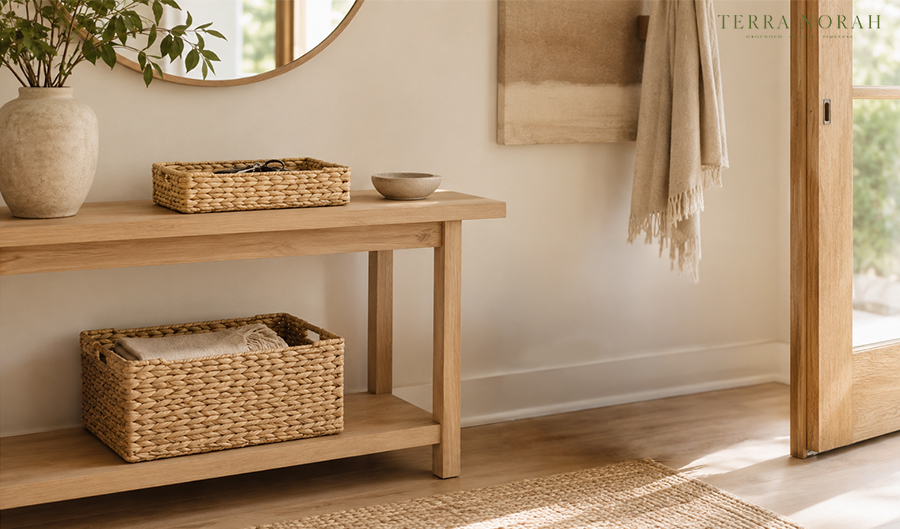
Measure your surface first. A basket that overhangs a console looks messy no matter how tidy the contents are, and it gets knocked every time you pass. Depth matters more than width here.
A low, wide basket suits this job well. Terra Norah’s Rectangular Water Hyacinth Basket with Round Handles works on a console for exactly that reason, though any shallow basket sized to your surface will do the job.
Shoes, and the honest truth about shoe storage
Shoes are the biggest visual clutter in any entryway, and most solutions overcomplicate them.
Racks and cubbies look great in photos because someone arranged them. In daily life, shoes get kicked off and left where they land. A single deep basket beside the door accepts that reality: shoes go in, done, and the floor stays clear.
A few things worth knowing before you set this up:
Size for your worst day, not your average one. Count how many pairs actually accumulate by the door on a busy week, not how many you think should be there. A basket that is always overflowing gets abandoned.
Wet shoes need a rule. This is the one real limitation of natural fiber. Water hyacinth handles everyday hallway life fine, but it does not like sitting in water. Let wet shoes dry on a mat first, or put a tray or liner in the bottom of the basket during winter. This single habit is the difference between a basket that lasts years and one that develops a musty smell in one rainy season.
Keep it off the wettest patch. Not directly under a dripping coat rack or beside an umbrella stand.
For a household that generates a lot of shoes, Terra Norah’s Oval Water Hyacinth Floor Baskets, Set of 2 handle the volume while reading as a decor piece rather than a shoe bin, which matters in a space guests see first.
Seasonal accessories, and why they belong in rotation
Scarves, hats, gloves, umbrellas, and reusable bags are the third zone, and the trick is treating them as seasonal rather than permanent.
Keep only the current season in the entryway. Winter gloves in July are just clutter taking up your best storage. Store the off-season set elsewhere and swap them twice a year. Your entryway holds a fraction as much this way, and the things you actually need are easy to reach.
Rolling rather than folding fits more in a basket and keeps everything visible, so you are not pulling out three scarves to find one. If you share the space, one basket per person works better than sorting by item type, because people remember their own basket without thinking about it.
Small entryways and apartments
If your entryway is a metre of hallway rather than a room, the rules tighten.
Limit yourself to two containers total: something shallow for small items and one deeper basket for shoes. Skip the seasonal zone entirely and keep accessories in a closet. A small entryway with three baskets looks cluttered even when everything is tidy, because the containers themselves become the visual noise.
Go vertical where you can. Hooks handle bags and coats better than any floor container in a narrow space, and they leave the floor clear, which is what actually makes a small hallway feel bigger.
For renters or anyone who moves often, a collapsible basket is worth considering since it folds flat between homes and fits standard cube shelving if you use one.
Keeping baskets in good shape in a high-traffic space
The entryway is harder on baskets than any other room. Grit, damp shoes, and constant handling all take a toll. Three habits cover almost everything:
Vacuum or brush the weave occasionally to clear outdoor grit before it works into the fiber. Wipe with a dry or lightly damp cloth rather than soaking, and let anything damp air-dry fully. Keep baskets off consistently wet floors and away from dripping coats.
That is genuinely it. Natural fiber is more forgiving than people expect. It just needs to stay dry.
Making it look intentional
A functional drop zone can still look like a drop zone. What makes an entryway feel designed rather than defaulted is restraint.
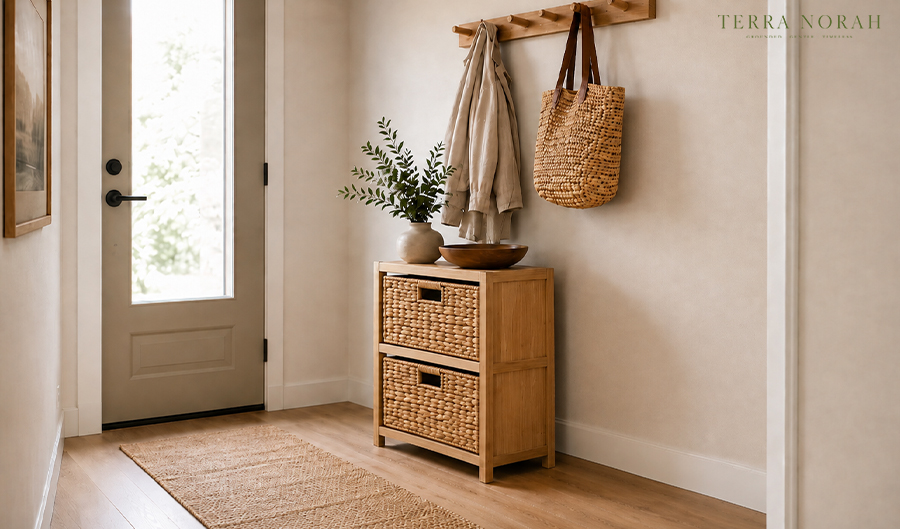
Pick baskets in the same tone so they read as a set instead of leftovers. Vary the scale, one large floor basket against one small tray, because matching sizes look flat. Leave visible empty space on your console rather than filling it, since breathing room is what separates styled from stuffed. A mirror above and a plant beside will do more than any additional storage piece.
The best entryways usually contain three things and a plant. Not eight.
Shop water hyacinth entryway storage from Terra Norah
At Terra Norah, every basket is handwoven from natural water hyacinth, built for the kind of daily use an entryway demands. Shallow catchalls, deep floor baskets, and everything between.
Explore our handwoven [water hyacinth baskets] and set up a drop zone that actually holds.
Frequently Asked Questions
What should I store in an entryway basket?
Keys, mail, sunglasses, and wallets in a shallow catchall. Shoes in a deeper floor basket. Current-season scarves, hats, and umbrellas in a third if you have room. Anything more usually goes unused.
Are woven baskets good for shoe storage?
Yes, because they accept shoes dropped in rather than placed neatly, which is what actually happens. Let wet shoes dry first or add a liner during winter.
Can water hyacinth handle a damp entryway?
It handles normal humidity fine but not standing water. Keep baskets off wet floors and away from dripping coats, and let anything damp dry fully.
How many baskets does a small entryway need?
Two. Something shallow for small items and one deeper basket for shoes. A third container in a narrow space adds visual clutter faster than it removes it.
How do I keep entryway baskets clean?
Vacuum or brush out grit occasionally, wipe with a dry or lightly damp cloth, and avoid soaking. Add a liner if you store anything wet or dirty.